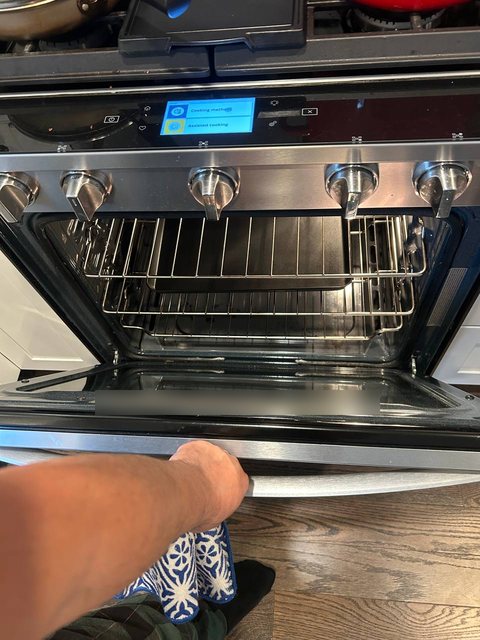
A Wolf burner that clicks and will not catch, an oven that stalls at 300 with the convection fan running, or a wall oven display showing an F-code.
Weekdays 8–6 · Saturday 9–3 · closed Sunday · truck based on 4425 Harbor Country Dr NW
Refrigerator & Freezer Repair$99 diagnostic · one figure, written
Washer Repair$99 diagnostic · one figure, written
Dryer Repair$99 diagnostic · one figure, written
Dishwasher Repair$99 diagnostic · one figure, written
Oven, Range & Cooktop Repair$99 diagnostic · one figure, written
Ice Maker Repair$99 diagnostic · one figure, written
Wolf ranges arrived here with the kitchen remodels of the last twenty years. The 36 and 48 inch gas ranges and rangetops sit in the waterfront houses on Harborview Dr and around Point Fosdick, the dual-fuel DF models in the Canterwood and Harbor Hill builds, and the E series and M series wall ovens in the renovated Craftsman kitchens of Proctor and the North Slope. The red knobs are the giveaway. What fails on these is rarely the heavy iron; it is the spark modules, the oven igniters that weaken with age, the door hinges and the temperature sensors, and on the wall ovens the cooling fan and the control that reports an error.
Geography decides the fault. In Gig Harbor proper and in Tacoma the ranges run on PSE natural gas, so the trouble is age and use. On Fox Island, in Artondale and out on the Key Peninsula the same range burns propane, and a unit that was never converted, or converted without the regulator switched, shows a tall yellow flame, sooted pans and a simmer that will not hold. Salt air off Carr Inlet and Commencement Bay pits the igniter electrodes and the spark leads so burners click without lighting. A PSE outage in a January windstorm, followed by a generator, is how a dual-fuel oven ends up with a control board that no longer talks to its relay board.
| Wolf unit | Typical sign | Likely cause | Our fix |
|---|---|---|---|
| Gas ranges (GR, R series) | Burner clicks continuously, no flame | Cracked or damp spark igniter, a spark module on its way out, burner cap left crooked after cleaning | Test spark at each electrode, meter the module output, dry and reseat, replace the electrode if pitted |
| Dual-fuel ranges (DF series) | Oven heats slowly or holds low, bake element fine | Oven temperature sensor drifting, relay board contact worn, convection fan motor dragging | Read the sensor in ohms at room temperature and at heat, check relay output, replace what is out of spec |
| Rangetops (SRT, RT series) | One burner low or uneven, others fine | Orifice partly blocked, burner tube misaligned, or a propane orifice on natural gas | Clear and size the orifice, check manifold pressure with a gauge, align the burner and confirm flame shape |
| Gas cooktops (CG series) | Flame lifts off the burner or burns yellow | Air shutter or regulator set for the wrong gas, low supply pressure on propane | Measure inlet and manifold pressure, set the regulator, adjust the shutter, verify with a blue steady flame |
| E series wall ovens | Display shows an error, door will not unlock after clean | Door latch motor or switch, cooling fan sensor, temperature probe fault | Read the code, cycle the latch by hand, meter the latch switch and fan, replace the failed part |
| M series wall ovens | Oven fan runs, no heat, or heats then cuts out | Bake or broil element open, sensor reporting a runaway, control relay stuck | Meter each element, compare sensor reading to an independent probe, check the relay board output |
| Indicator | Meaning | Action |
|---|---|---|
| F1 | The oven control detected a fault in its own circuitry or keypad | Power down, retest, check the keypad ribbon and control before ordering a board |
| F3 | Oven temperature sensor circuit is open, so the control cannot read heat | Meter the sensor and its harness at the plug, replace the sensor or repair the connection |
| F4 | Oven temperature sensor circuit reads shorted to the control board | Check the sensor for a short and the wiring for chafing where it passes the oven liner |
| F5 | Latch never confirmed a fully locked or fully unlocked state | Check latch motor and switches, straighten a bent latch, fit a new motor if it stalls |
| F9 | Door lock circuit fault during a self-clean or after a power interruption | Confirm the door is closed, cycle the latch, meter the lock switch and the control output |
A Wolf diagnosis begins with gas pressure, because a range cannot be judged until the supply is known. The manometer goes on the manifold test port, we read inlet and manifold pressure, and on propane we check that the regulator was actually converted. Then each burner is lit and watched for shape and color, the igniters are tested for spark and for the current draw on oven igniters, and the sensor is metered against its resistance chart. On wall ovens the stored error code sets the order of the tests. The truck carries spark modules, electrodes, oven igniters, sensors and the common latch parts. A relay board, a door hinge assembly or a specific burner head goes on order, and the visit to fit it adds nothing to your bill.
We are an independent shop and not a Wolf dealer, so our interest is only in the repair being right. If your range or oven is new enough that the maker’s own coverage might still apply, we say so first and let you choose. Owners of Fox Island and Key Peninsula vacation homes get a photo, approve by text, and find the invoice and its written warranty in their email; gate codes and lockboxes are routine for us. The money works one way on every Wolf. The diagnostic runs $99, and that sum is buried in the repair figure you sign off on. Walk away instead and $99 is where it ends. You will not find repair figures quoted on this page, because a number is written only once the meter has done its work, and nothing is added for the bridge.
Yes. Conversion is a regulator change plus the correct orifices on every burner, and then the flame is checked against a gauge reading, not by eye. Many Fox Island and Key Peninsula ranges were installed with half the job done. We tell you what was missed, put the number in writing, and finish it properly.
Water under the burner caps and around the electrodes shorts the spark to ground, so the module keeps firing. Let it dry a day; if the clicking continues, an electrode is cracked or the module is weak. We test spark at each burner and meter the module before naming the part.
We do, and the price card is identical on either side of the Narrows. The toll runs eastbound only and never appears on your invoice. Wall ovens in the older North End houses often sit in tight cabinets, and we bring the tools to remove them without marking the woodwork.
F3 means the control sees an open circuit where the oven temperature sensor should be, so it cannot read the heat and halts the bake. It is usually the sensor itself, sometimes the plug behind the oven where the harness has cooked. We meter both, then write the single price before anything is swapped.
The burners will light with a match regardless. The electronics are the risk: a surge when power returns, or rough power from a portable generator, can take out the spark module or the oven control on a dual-fuel model. We test the boards after a storm before anyone decides the range is done for.
Phone or form, either way a dispatcher sends a two-hour window and a text the moment the truck rolls — from Harbor Country Drive, or off the bridge deck for Tacoma stops.
Clamp meter, thermometer, manometer where propane is involved. The failed component is identified and explained, and one figure goes on paper with the $99 built into it.
The truck carries what salt air, iron water and outages break: fill valves, defrost heaters, igniters, rollers, relays. Anything ordered comes back on our schedule, not your bill.
A complete run of the machine while you watch, the floor and panels put back as found, and the warranty term printed on the invoice.
$99 gets the meter on it, the figure goes on the ticket, the part is usually already on board, and the coverage term is printed on the invoice. Same card on both shores of the Narrows.